LitBuy's own example pictures, and what each one asks of you
Two tables and eleven photos from one LitBuy help article, updated 7 July 2026. The tables are typed out in full; each photo comes with what it shows, what to copy and what it cannot prove.
Where the thirteen pictures come from
All thirteen images sit inside one LitBuy help article titled "What should I do if there is an issue with my package after delivery?". It is filed under FAQ for shipping, and its update stamp reads 7 July 2026, 15:18. We read it on 16 October 2026. Deep links to single help articles reload the help centre's front page when opened cold, so the reliable route is LitBuy's help centre, then the shipping FAQ.
The article is unusual in one respect: two of its key tables exist only as pictures. The time limits and the required documents are not in the page text at all, which means translation tools and screen readers skip them. We have typed both out below, word for word where it matters, so you can search them and quote them back in a ticket.
Picture 1: the time-limit table
The first table has three rows and one surprise: the clock does not start when the parcel lands. For damage, wrong or missing items, quality problems, and for parcels marked Delivered that never reached you, the 7 days begin on the day after the tracking turns to Delivered. LitBuy's own example uses 7 August, with the request due before midnight on 14 August.

| Scenario (LitBuy wording) | After-sales time limit | LitBuy's own example |
|---|---|---|
| Package damaged, incorrect items, missing items, or product quality issues | Within 7 days, starting from the day after the tracking status shows Delivered | Delivered on 7 August: request before 24:00 on 14 August |
| Tracking shows Delivered, but the customer did not actually receive the package | Within 7 days, starting from the day after the tracking status shows Delivered | Delivered on 7 August: request before 24:00 on 14 August |
| No tracking updates or package suspected to be lost | Within 60 days from the date of the last tracking update | Last update on 7 August: request before 24:00 on 7 October |
The third row is the only one measured from something other than delivery: the last tracking update. That is why the stepper on this site asks you to note that date before anything else when a parcel goes quiet.
Picture 2: the required-documents table
The second table matters more day to day, because it tells you what to shoot before you know whether you will need it. Five issues, five lists. The unboxing video appears in three of them and is marked required for damage. The scale photo appears for missing items and for weight disputes, and nowhere else.
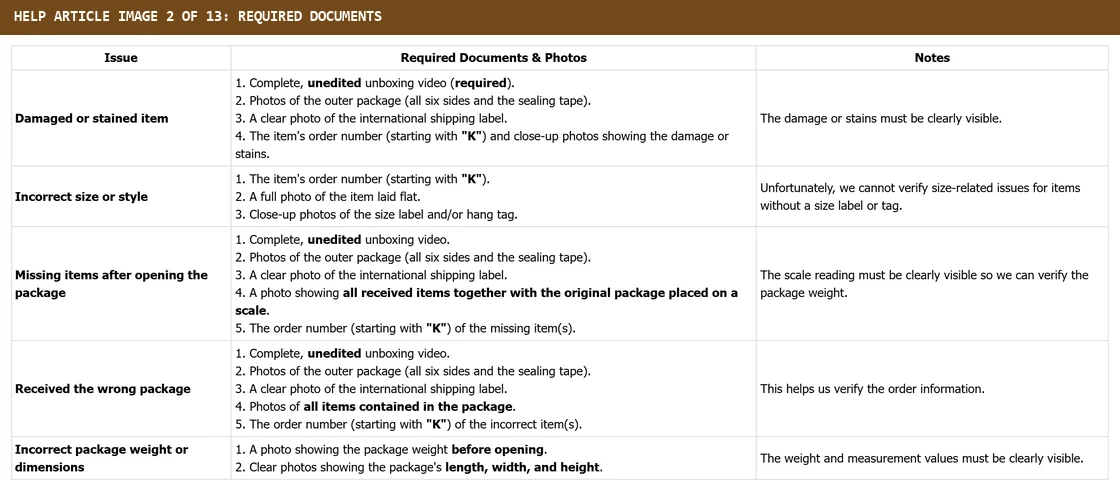
| Issue | Documents and photos LitBuy lists | LitBuy's note |
|---|---|---|
| Damaged or stained item | Complete, unedited unboxing video (required); photos of the outer package, all six sides and the tape; a clear photo of the international label; the K order number with close-ups of the damage or stains | The damage or stains must be clearly visible |
| Incorrect size or style | The K order number; a full photo of the item laid flat; close-ups of the size label or hang tag | Size issues cannot be verified for items without a size label or tag |
| Missing items after opening | Unedited video; six sides and tape; the label; all received items together with the original package on a scale; K numbers of the missing items | The scale reading must be clearly visible so the parcel weight can be checked |
| Received the wrong package | Unedited video; six sides and tape; the label; photos of all items in the package; K numbers of the incorrect items | Used to verify the order information |
| Incorrect package weight or dimensions | The package weight before opening; clear photos of length, width and height | Weight and measurements must be clearly visible |
Read the notes column twice. Two of its five notes are refusals in advance: without a size label LitBuy says it cannot verify a size problem, and an unreadable scale cannot be used to check the parcel weight.
Photo 1: the warehouse security seal
The first example photo is a sealed box with a white label headed "Check before signing". It is LitBuy's warehouse seal, and it carries its own short rulebook in four boxes: after-sales requests within 7 calendar days after delivery; record the whole unboxing and do not edit or cut the video, otherwise the request is invalid; check that the package is sealed and undamaged before signing; and a disclaimer about non-quality problems, human damage and missing evidence.
One line on that label disagrees with the help article. The label says that if you find a problem before signing you should refuse the delivery and contact customer service. The article recommends accepting rather than refusing whenever possible. We explain how we read that on the carrier page.
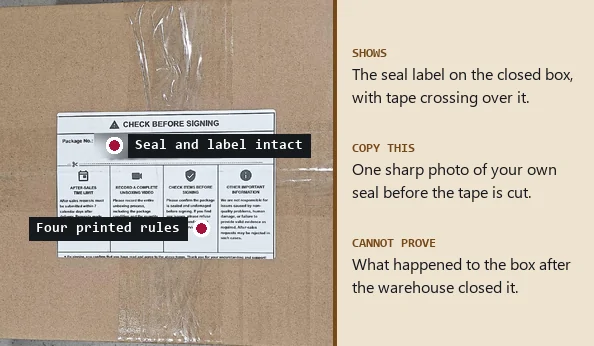
Photo 2: the international shipping label
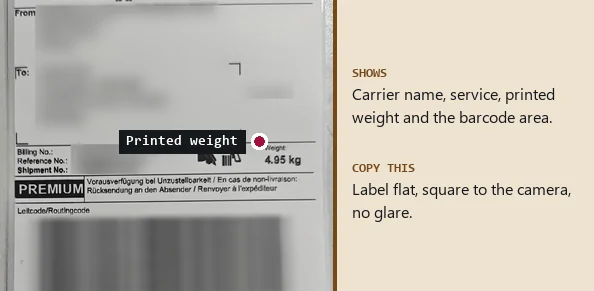
LitBuy's label example is a Deutsche Post Paket International label, with the sender and recipient already blurred by LitBuy and a printed weight of 4.95 kg. We blurred the billing, reference and shipment numbers that were still partly visible. On your own photo, keep everything readable: the ticket goes to LitBuy, not to the public.
The label ties the box in your hands to the tracking number in your account, and the printed weight gives LitBuy a number to compare with your scale photo. Shoot it flat and square, without glare from the plastic sleeve. If the label is torn or wet, photograph it as it is, then add a second shot of the damage.
Photos 3 and 4: six sides, and the side that was hit
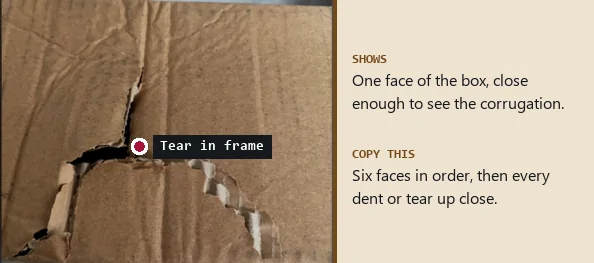
The six-sides example is a plain carton top crossed with layers of clear tape; the next photo is a side wall torn open in a T shape. LitBuy asks for all six sides including the sealing tape, plus clear photos of any damaged area. Six photos feels excessive until a claim turns on whether a corner was crushed before or after the box was opened.
Turn the box, do not move the camera: same distance, same light, one face at a time. If you film the six sides in the video, still take the stills; a frame grabbed from a video is softer than a photo.
Photos 5 and 6: the scale and the tape measure
The scale example shows an unopened box on a bench scale whose display reads 1.615. The measuring example shows a tape run up the full height of a carton, with the seal label beside it. Both were plainly taken in a warehouse: shelving, plastic crates, a concrete floor. That is LitBuy demonstrating the shot, not a shopper's doorstep.
Why these two matter: once your parcel is packed, LitBuy's staff put it on their own scale and record its size, and those readings decide the bill. Your scale photo before opening is the only way to show the box you received weighed less than the box that left. A kitchen scale works if the whole parcel fits and the display is readable in the shot.
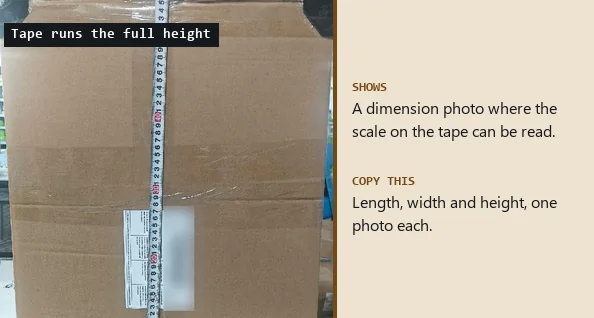
Photo 7: the order number starting with K
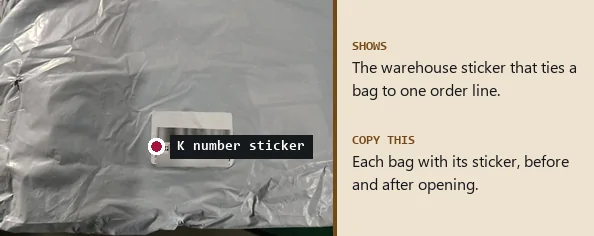
Inside the parcel, LitBuy repacks items in its own bags and labels each with the order number. The example photo shows a grey bag with a white sticker; the number begins with K. In LitBuy's table that K number appears in four of the five issue lists, because it links a physical item to a line in your account.
Photograph each bag with its sticker before you tear it, and again with the product next to it once opened. For missing items, list the K numbers of what did not arrive; for a wrong package, the K numbers of what you expected.
Photos 8 and 9: damage and stains up close
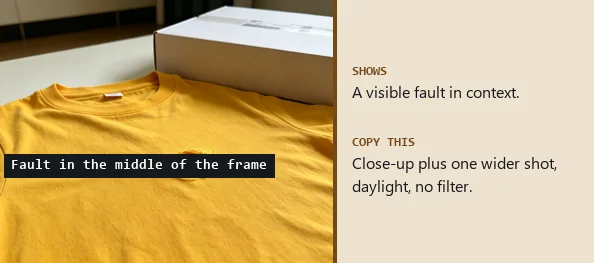
The two damage examples are a yellow T-shirt with a ragged hole on the chest, set next to a white shipping box, and a pair of white trainers with a yellow-brown stain across one toe. Both are clean, well lit images, closer to studio shots than to a phone photo on a kitchen table.
The lesson is composition, not polish. The fault fills enough of the frame to be unmistakable, and there is enough of the item around it to know which item it is. Take one close-up and one wider photo for every fault, in daylight, and include the K-number sticker in at least one of them.
Photos 10 and 11: the size tag and the flat lay
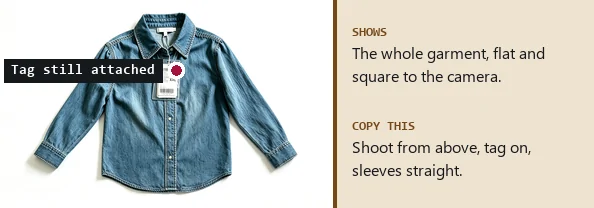
The last two examples are a denim shirt seen close up with a clear plastic hang tag reading XXL, and the same shirt laid flat on a white floor, sleeves out, nothing folded under. For an incorrect size or style, these two plus the K number are the whole list.
A flat lay only helps if the item is truly flat and photographed from straight above. Stand on a chair if you need to. If you have the seller's size chart, measure the item on camera too; LitBuy does not ask for it, but it turns "it feels small" into a number.
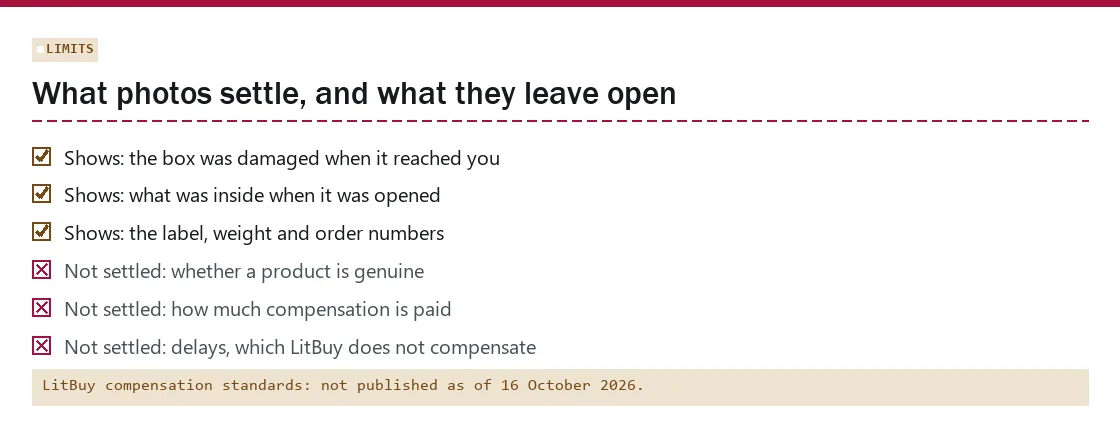
What none of these pictures can prove
Good evidence shows condition: a box that was crushed, an item that was missing, a stain that was there when the bag was opened. It cannot show whether a product is genuine. LitBuy's policies ban fake and IP-infringing products and reserve the right to cancel those orders and destroy that stock; elsewhere LitBuy concedes that it cannot vouch for authenticity. No photo on this page changes that.
The pictures also say nothing about payout. LitBuy pays approved compensation to your account balance under its own insurance compensation standards, and those standards are not published. We will not guess at amounts. What we can say is narrower: a claim missing the photos in LitBuy's table starts from a weaker place.