Report to the local carrier first, then to LitBuy
LitBuy's after-sales article puts the local carrier ahead of LitBuy itself. Here is what to do at the door, what to ask for within 48 hours of Delivered, and how to read LitBuy's conflicting advice on refusing a parcel.
Why the local carrier hears about it first
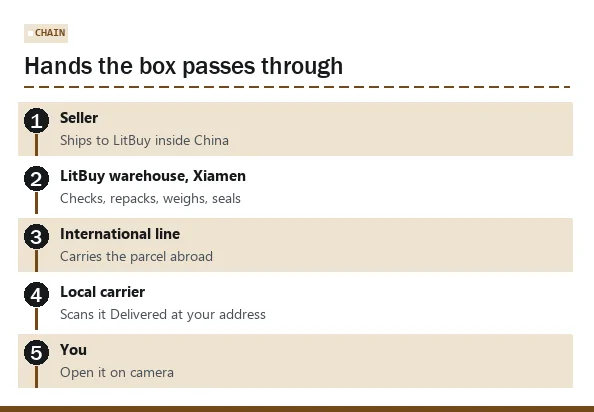
By the time a parcel reaches your street it has passed through several hands: the seller, LitBuy's Xiamen warehouse, an international line and finally a local carrier. The last of those scanned it as Delivered, and only that company can open an investigation into its own delivery, examine its own scans, or accept its own liability.
LitBuy's role comes after. Its help article says that once you have the evidence it will help you submit a compensation claim to the carrier. That only works if the carrier already has a record of your complaint, which is why the article asks for a damage report or a case number within 48 hours of Delivered. A complaint filed later is still worth filing, but it starts behind.
When the courier is standing at your door
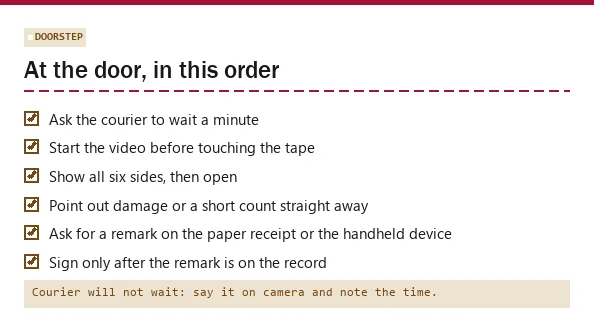
If you can take the parcel in person, LitBuy's first instruction is to open it in front of the courier while recording one continuous video. If anything is damaged or missing, tell the courier on the spot and ask for a remark on the delivery record. LitBuy suggests wording along the lines of "Outer packaging damaged; contents damaged/missing".
How that remark gets made depends on the receipt. On paper, the courier writes it by hand. On an electronic signature pad, ask them to add the note on their handheld device before you sign. Couriers are busy; some will refuse to wait. If that happens, say so in your video, note the time and the courier's name or ID if visible, and move to the 48-hour complaint.
Accept or refuse: three LitBuy texts disagree
This is the most confusing point in LitBuy's material, so we set the three texts side by side. The help article updated in July recommends accepting rather than refusing whenever possible, because a refused parcel can be sent back to China or destroyed by the local carrier. The seal label on LitBuy's own example box says that if you find any issues before signing you should refuse the delivery and contact customer service. The older receipt notes say the delivery can be refused immediately if there are issues.
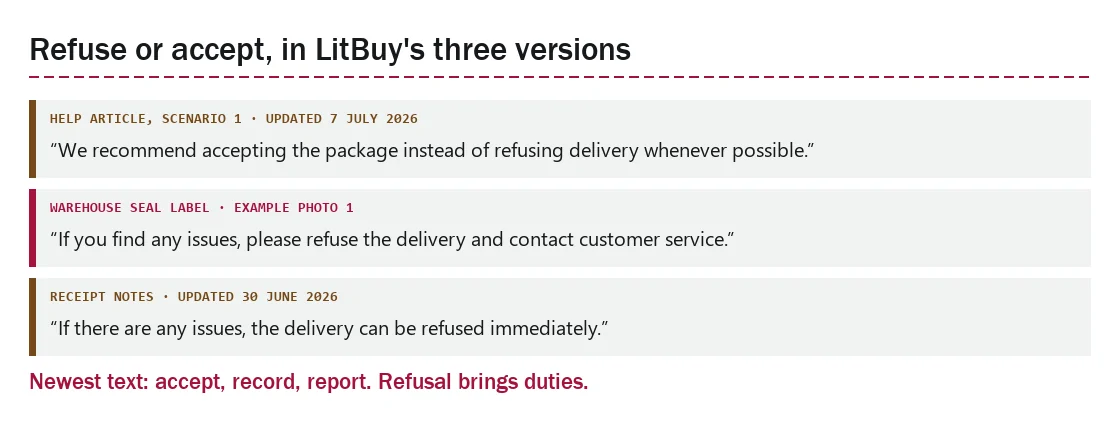
Our reading, and it is only that: follow the newest page, which is also the one that spells out consequences. Accept the parcel, record everything and get the courier's remark. If the damage is so bad that you do refuse, the same article says you must then cooperate with the local carrier by filing a damage report or claim; refusing without that, so that the parcel is returned or destroyed, leaves the return shipping and the risk with you.
When nobody signed for it in person
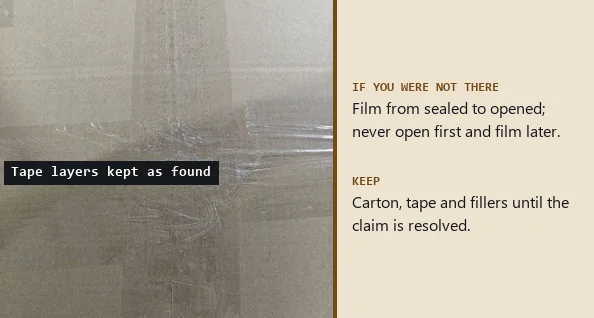
Parcel lockers, building reception, a neighbour, a family member: LitBuy calls this scenario 2, and the instructions shift. Do not open the parcel until the camera is running, record the same complete video, and keep the original carton and every piece of tape intact.
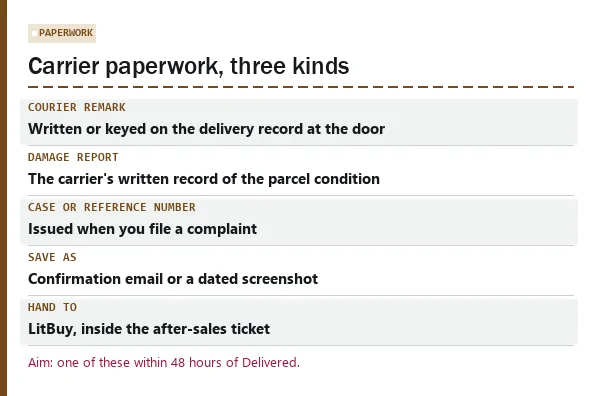
Then, within 48 hours of the tracking showing Delivered, contact the local carrier (LitBuy names EMS, DHL and UPS as examples) to file a claim or complaint and obtain either a damage report or a case or reference number. The older receipt notes put it as keeping the outer box and tape for up to 2 days after signing and reporting to the local post office. Same direction, shorter wording.
What a damage report or case number looks like
Carriers use different names. A damage report is a written record from the carrier about the condition of the parcel, often produced after you file a damage claim online or a driver inspects the box. A case number, ticket number or reference number is what most carriers send after an online complaint. Either satisfies LitBuy's wording; you need one of them, not both.
Keep the confirmation email or a screenshot of the complaint page showing the number, the date and the tracking number. If the carrier tells you that the sender has to file, write that down too, with the date and the channel. LitBuy's article says it will assist with the claim to the carrier; giving it the carrier's own words saves a round trip.
Delivered on the tracking, missing at your door
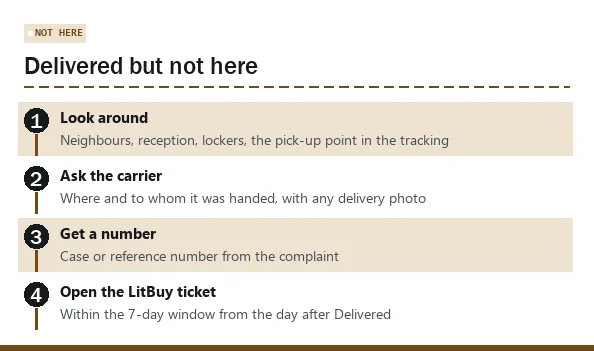
A Delivered scan with no parcel is a carrier problem first. LitBuy explains "Out for delivery" as a parcel that went out with a driver but was not handed over, for example because nobody was home, and suggests contacting your local post office or courier for the delivery status.
Check the obvious places, then ask the carrier where and to whom it was handed: some carriers hold a photo or GPS point for each delivery. Get a case number. Your request to LitBuy for a Delivered parcel that never arrived follows the same 7-day rule as damage, counted from the day after the Delivered scan.
Where carrier claims stop
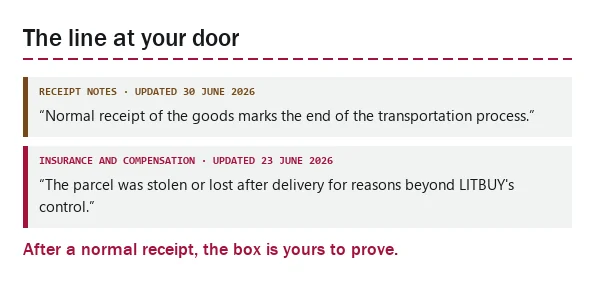
LitBuy draws a hard line at normal receipt. Its receipt notes say that normal receipt marks the end of the transport process and that LitBuy is not responsible for incidents after the goods are normally received. Its insurance page lists a parcel stolen or lost after delivery, for reasons beyond LitBuy's control, as a case it will not compensate.
In practice the doorstep is the boundary. Whatever you want to claim later, the box has to be shown in the state it arrived, before it disappears into a hallway or a recycling bin. That is the whole argument of this site in one sentence: the evidence is made at the door, or not at all.