What LitBuy charges, how money moves, and how parcels travel
The money and shipping facts that shape a claim: two payments per order, two places money comes back to, a billing weight set in the warehouse, and tracking that can legitimately go quiet for days.
The cost of a LitBuy order, piece by piece
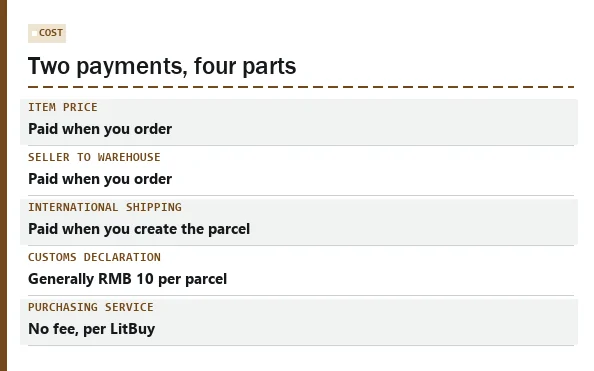
LitBuy's service-fee article lists what an order costs: the item price plus the seller's shipping to the warehouse, international freight priced by weight, line and country, plus a customs declaration charge that LitBuy puts at generally RMB 10 per parcel, varying by line. It says the shopping agent service itself is free.
You pay in two moments. The item and domestic shipping are paid when you order; international shipping, declaration and any extras are paid when you create the parcel. For a claim, keep both payment records: compensation for a lost parcel is judged on the parcel, while a refund for a returned item follows the item.
Buying costs and delivery costs answer different questions
The first payment gets the selected goods from the seller into the buying process, including the relevant local charges. The later shipping payment concerns a parcel with chosen contents, packing and destination. Allow for conversion, payment handling, optional services and applicable import charges rather than spending the whole budget on product prices.
For a fragile item, compare adequate protection with the resulting packed dimensions. Removing a box solely to lower a quote may make delivery damage more likely or remove evidence about original condition. Consolidation can avoid repeated charges but does not guarantee the cheapest result. Retain the selected services, final parcel bill and item list; they explain what was purchased and how it was supposed to travel.
Small charges outside the zero fee
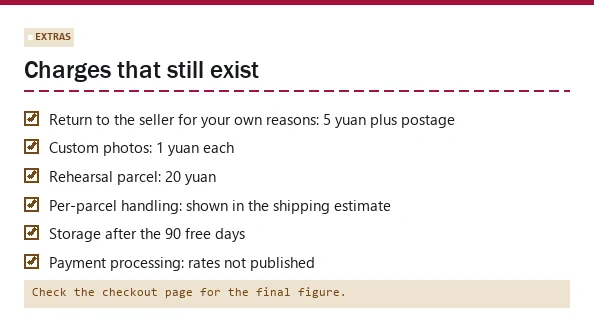
No purchasing fee does not mean no fees. LitBuy's own pages list a fixed 5 yuan service charge when you return something to a seller for your own reasons, on top of the return postage and the seller's original shipping; custom photos at 1 yuan each; a rehearsal parcel at 20 yuan; a per-parcel handling charge that shows up in the shipping estimate; and storage fees once the 90 free days are over.
None of these are large, and none of them are hidden, but they matter when you weigh a claim against a return. A wrong size you could have spotted in a custom photo costs 1 yuan before shipping and much more after.
Exchange rate and the currency you pay in
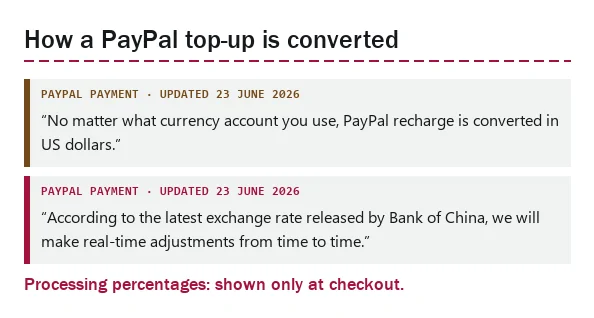
LitBuy prices goods in yuan. Its PayPal article says every PayPal top-up is settled in US dollars, even from a euro or pound account, and that the conversion tracks Bank of China rates with periodic adjustments. The PayPal billing address must match the shipping address you give LitBuy.
Wire transfers cost the sender a bank fee, which LitBuy gives as 0.1% + 2.5 US dollars from a Hong Kong account and 0.1% + 7 US dollars from anywhere else. Paying from your LitBuy balance or with coins has no fee. Card and wallet processing percentages are not published; you see them at checkout. For claims, the point is simple: compensation lands in your balance, in LitBuy's currency.
Where refunds and compensation land
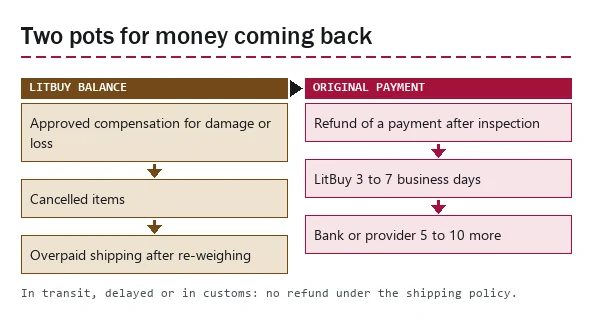
LitBuy keeps two pots. Approved compensation for a damaged or lost parcel, cancelled items and overpaid shipping go to your LitBuy balance or wallet. Refunds of a payment go back only to the original payment method, after LitBuy's 3 to 7 business days plus 5 to 10 at the bank or payment provider.
Some money may stay with LitBuy even then, according to the refund terms: freight already paid, service and payment-processing charges, customs duties and taxes, and work already done such as buying, storing or handling. The shipping policy refuses refunds for any parcel that is still moving, running late or sitting in customs.
Shipping lines, priced on LitBuy's own quote page
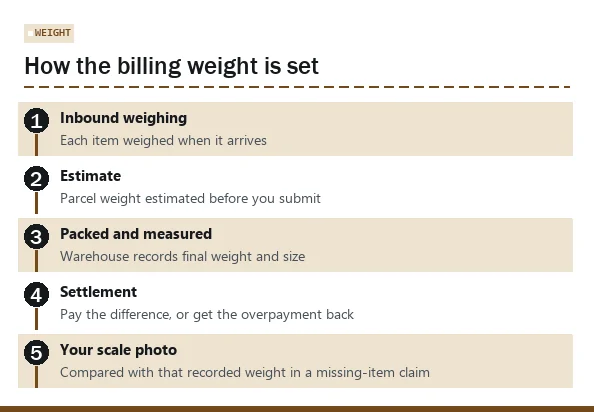
LitBuy's freight estimator is public: pick a destination, a weight and dimensions, and it lists the lines that accept the parcel with their price and time window. Prices and windows change, so read them on the day; we do not reprint them here. Many lines charge on the greater of actual and volumetric weight, using their own divisor; some charge actual weight only. Check the chosen line’s rule.
For evidence, the useful part is what happens after packing. Xiamen staff record the packed weight and box size, and LitBuy treats those figures as final unless the carrier corrects them. That recorded weight is what your scale photo will be compared with if something is missing. Try the estimator at litbuy.com/shipping-estimate.
Delivery estimates by region
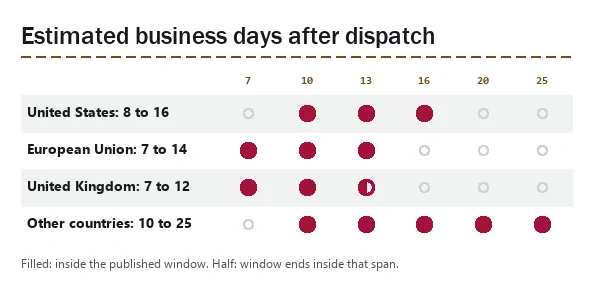
LitBuy's footer shipping policy gives four regional estimates, all counted from the moment the parcel ships rather than the order date, and all marked as estimates, not guarantees. For American addresses it is 8 to 16 business days; for the EU, 7 to 14; for Britain, 7 to 12; anywhere else, 10 to 25. Processing before dispatch takes 1 to 3 business days.
The same policy treats hold-ups caused by customs, weather or carriers as neither a failed delivery nor a breach of contract, and LitBuy's insurance page offers no delay compensation. A late parcel is a reason to watch the tracking, not yet a claim. The 60-day rule exists for a parcel that stops moving altogether.
Tracking gaps, and when silence becomes a claim
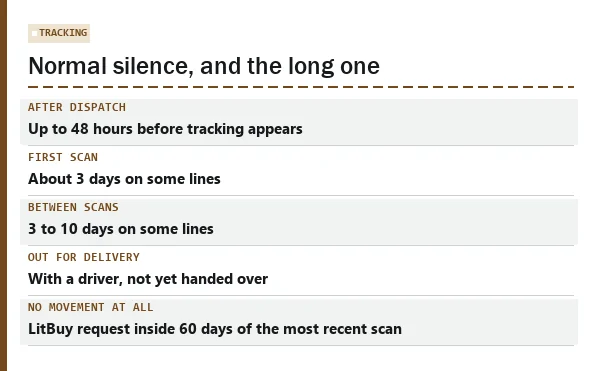
Tracking can take up to 48 hours to appear after dispatch, says the shipping policy. LitBuy's tracking article adds that on some lines the first update arrives about 3 days after shipping, and that after the first scan the next one can take 3 to 10 days, depending on the line. LitBuy shows a reminder under parcels on slow lines.
A gap can be normal on some lines, but do not wait for 60 days to ask about an unexplained delay. The 60-day rule is a request deadline in the time-limit table: the request must reach LitBuy no more than 60 days after the most recent tracking scan. Note that date when the tracking stops, and ask LitBuy before the window gets close. A parcel shown as held at customs is a pause with a reason; the carrier's own tracking page usually says what it is waiting for.
Customs, the EU parcel charge and TAX FREE lines
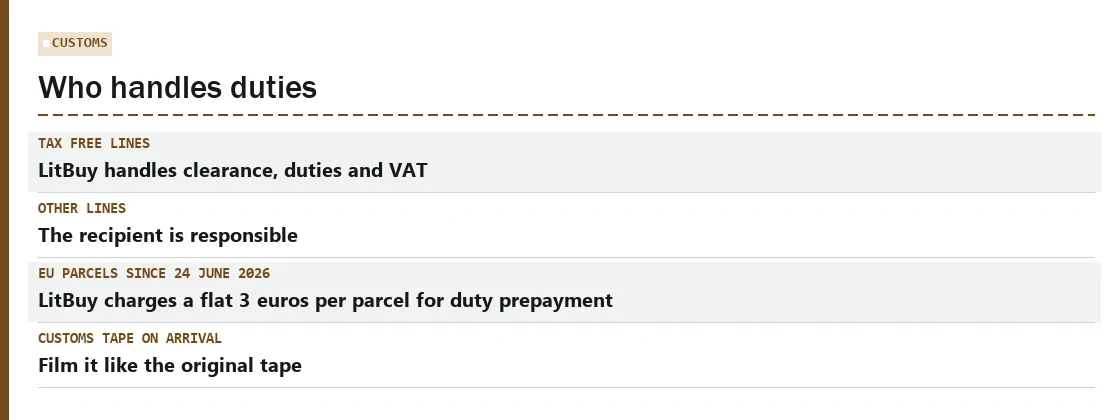
Under LitBuy's shipping policy, on TAX FREE lines LitBuy takes care of clearance and pays the duties and VAT itself; on every other line those costs and formalities fall to the customer. For the EU, a notice of 24 June 2026 says LitBuy handles the duty prepayment and charges a flat 3 euros per parcel, whatever the number of product categories inside.
Customs matters to evidence in one way: a parcel held or inspected by customs may be opened and resealed, and LitBuy's exclusions include goods confiscated or disposed of by authorities. If your box arrives with customs tape on it, film that tape as carefully as LitBuy's own.